Ideas that start from everything you already know.
A blank whiteboard wastes your archive. Brainstorm is an ideation canvas where an agent grounded in your programs surfaces prior art, rejected alternatives, and known constraints as you explore — so directions are pressure-tested before anyone commits a solver run to them.
Explore wide. Stay grounded.
Grounded chat
Ask what-if questions in plain language. The agent answers from your archive — with citations — not from the open internet.
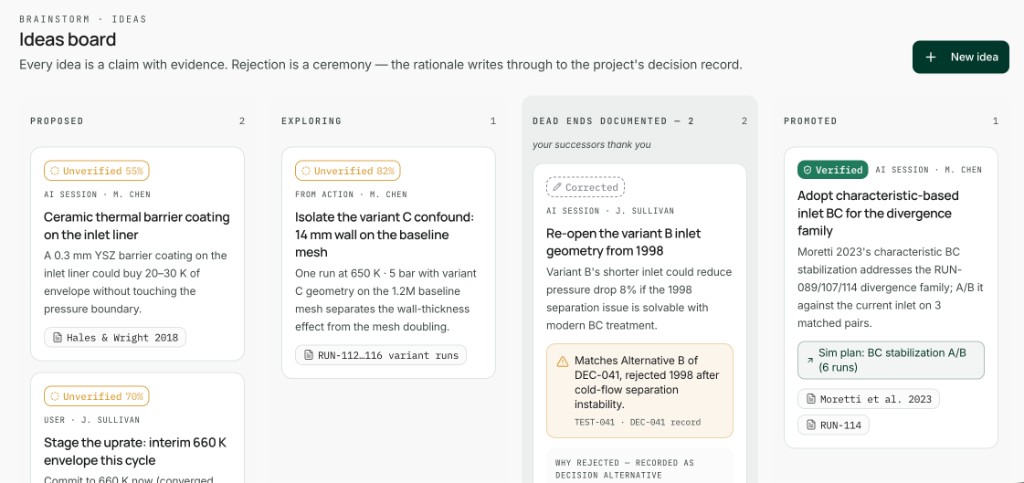
Idea board
Directions crystallize into structured cards: material options, geometry concepts, open questions — each linked to its supporting evidence.
Precedent surfacing
Similar problems solved in prior programs appear alongside your ideas, including the alternatives that were tried and rejected.
Constraint awareness
Known limits — standards clauses, supplier realities, past failures — attach themselves to ideas before they get expensive.
Session memory
Brainstorms become part of the project record. The reasoning behind chosen directions carries forward into analysis and simulation.
Handoff to solvers
Promising directions promote directly into Solve & Simulate with their context attached — no re-explaining the problem.
Diverge. Ground. Converge. Promote.
Diverge
Sketch directions freely in chat and on the board. Nothing is lost; everything is attributable.
Ground
The agent enriches each direction with precedent, constraints, and prior outcomes from the knowledge graph.
Converge
Compare directions with their evidence side by side. Rejected options are kept — with the reason — for whoever asks later.
Promote
Selected directions move into the lifecycle as tracked work, carrying their full brainstorm context.
Brainstorm questions.
01How is this different from a chatbot?+
02What does the agent know on day one?+
03Can rejected ideas be revisited?+
Stop brainstorming from zero.
A 30-minute walkthrough of Brainstorm running against a real engineering scenario.