Engineer faster. Prove everything. Lose nothing.
Cognis is our flagship engineering workspace—a unified platform where engineers ideate, analyze, simulate, document, and collaborate, with every decision fully traceable to your data, your standards, and your expertise.
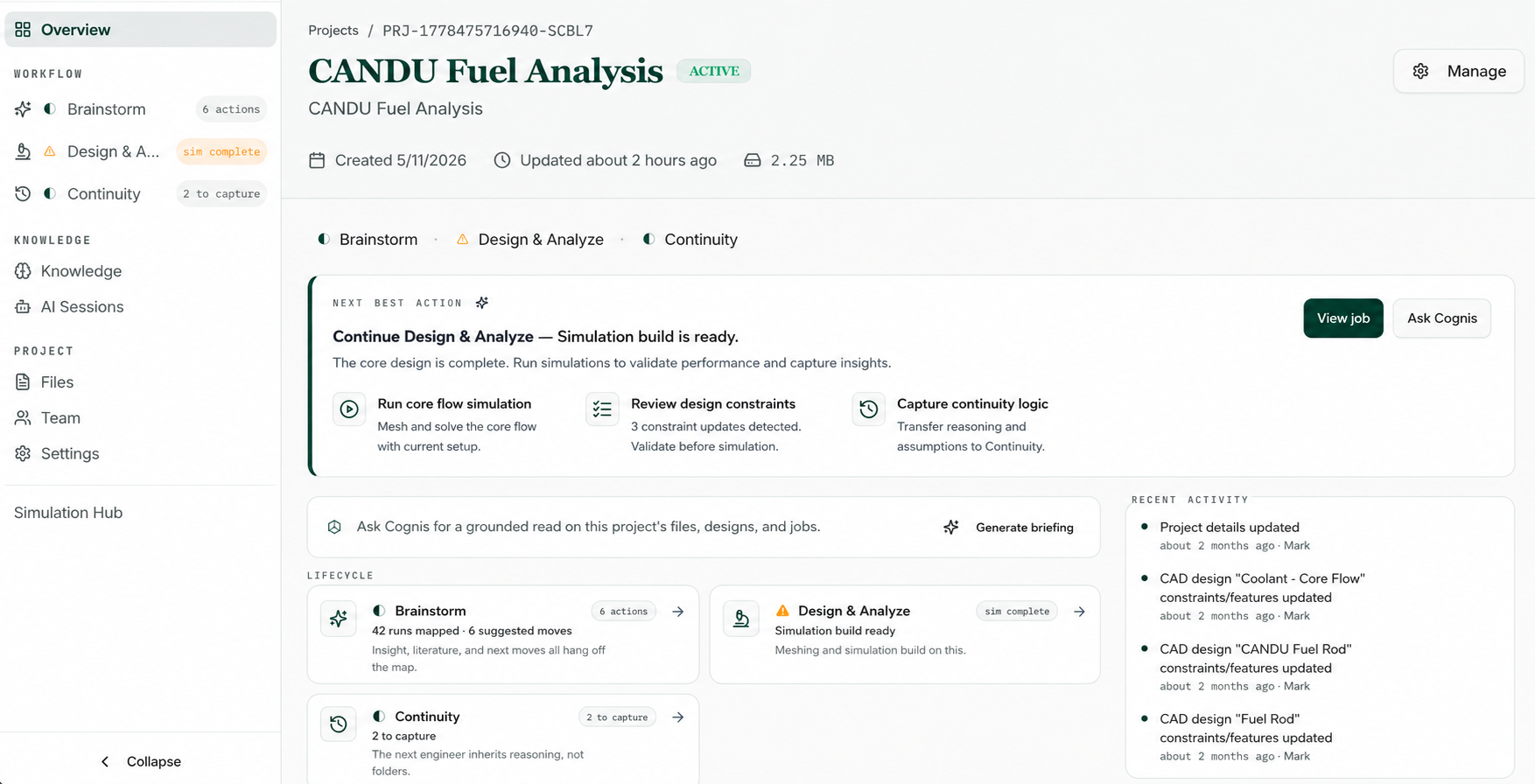
One harness. The entire engineering lifecycle.
Deep-tech work is scattered across solvers, PLM vaults, standards binders, test archives — and the heads of a few senior engineers. Point tools automate fragments; the judgment connecting them stays trapped.
Cognis is the harness underneath: AI agents that operate across every stage — brainstorm, analyze, simulate, verify, hand off — on one knowledge graph of your artifacts and decisions. Not five tools. One system that carries the why from first sketch to signed-off handoff.
Five stages. One agentic thread.
Every stage runs on the same harness and the same knowledge graph — so nothing is re-entered, re-derived, or re-learned along the way.
Ideate with an agent that knows your archive.
Explore design directions in a grounded canvas. The agent surfaces prior art, rejected alternatives, and known constraints from your own programs — so ideas start from institutional memory, not a blank page.
Explore Brainstorm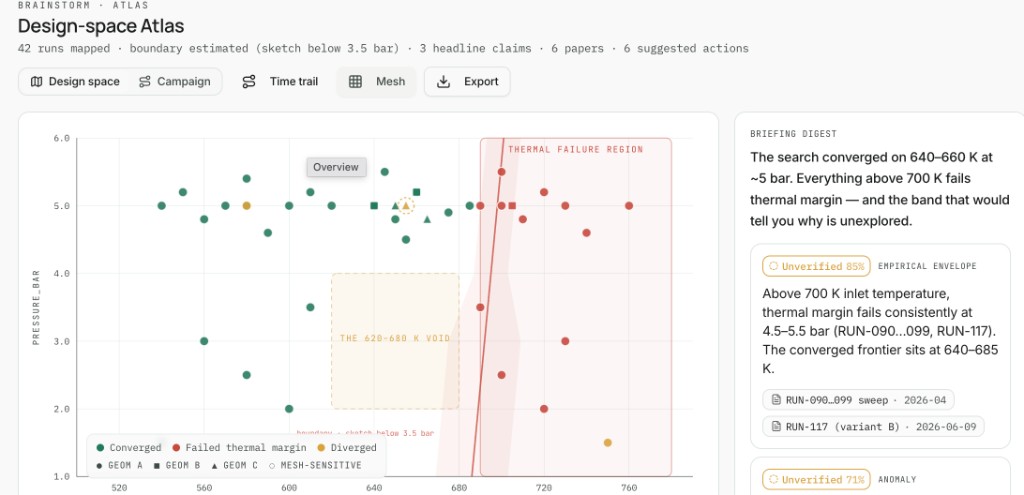
Ask in plain language. Get cited answers.
Query specs, test reports, simulations, and standards across every connected system. Every answer carries citation chips back to the exact artifact — the revision, the page, the run — so engineers verify instead of trusting.
See how retrieval works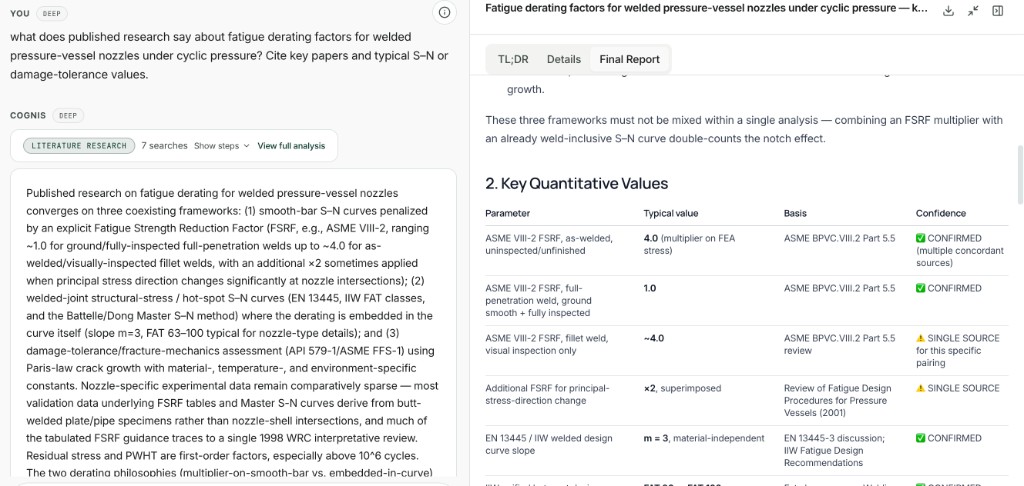
Agents that run solvers, not just describe them.
Configure and launch simulation runs from the workspace. The agent sets up parameter sweeps, tracks run history, and links every result to the design revision and requirement it validates — a live record, not a folder of outputs.
Explore Solve & Simulate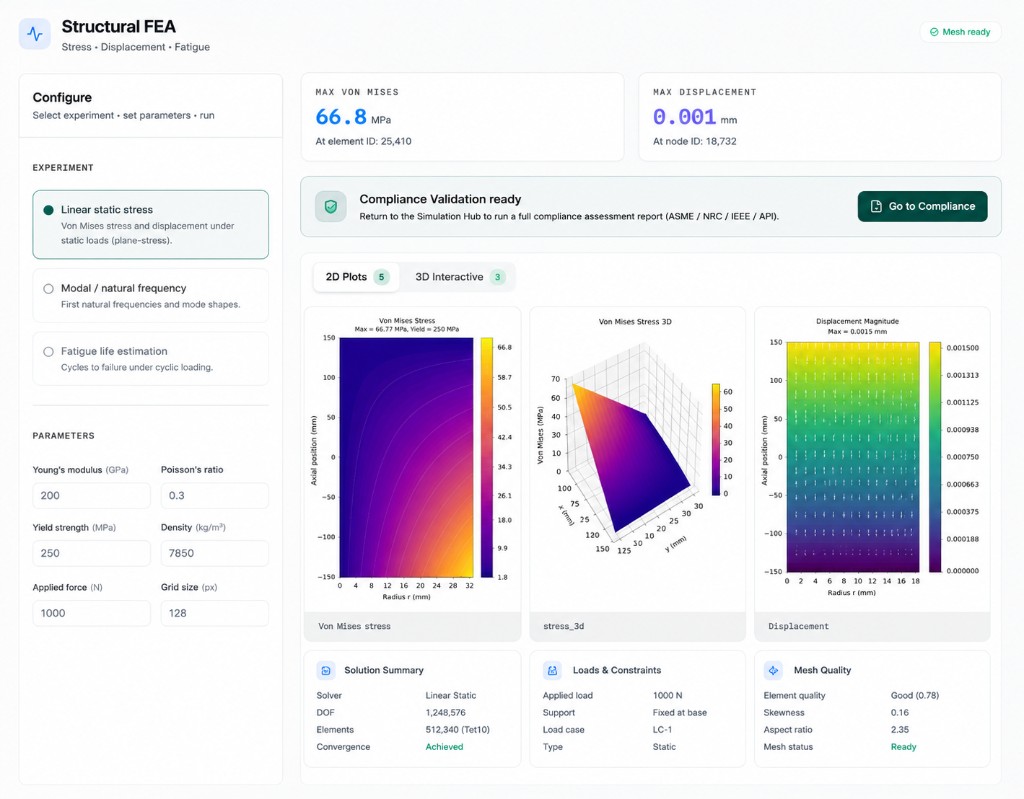
Compliance checked clause by clause.
Designs are checked against the standards you actually work to — clause by clause, with margins and flagged items. Reports compile themselves from work already done in the harness, every figure traceable to its source.
Explore Verify & Report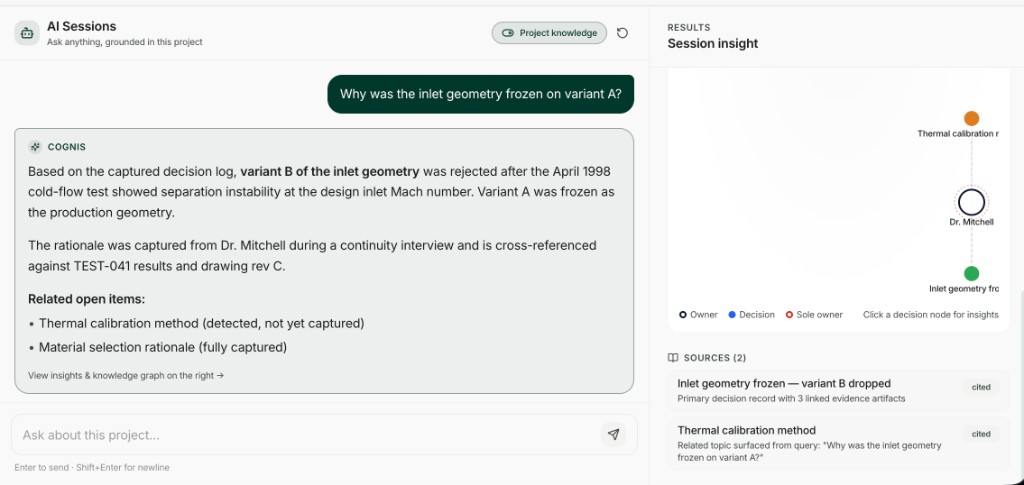
Capture the why before it walks out the door.
The harness watches for consequential, undocumented decisions and prompts the expert with one sharp question — then binds the answer to the exact artifacts. Departing engineers leave a navigable handoff, not a two-week overlap.
Explore Continuity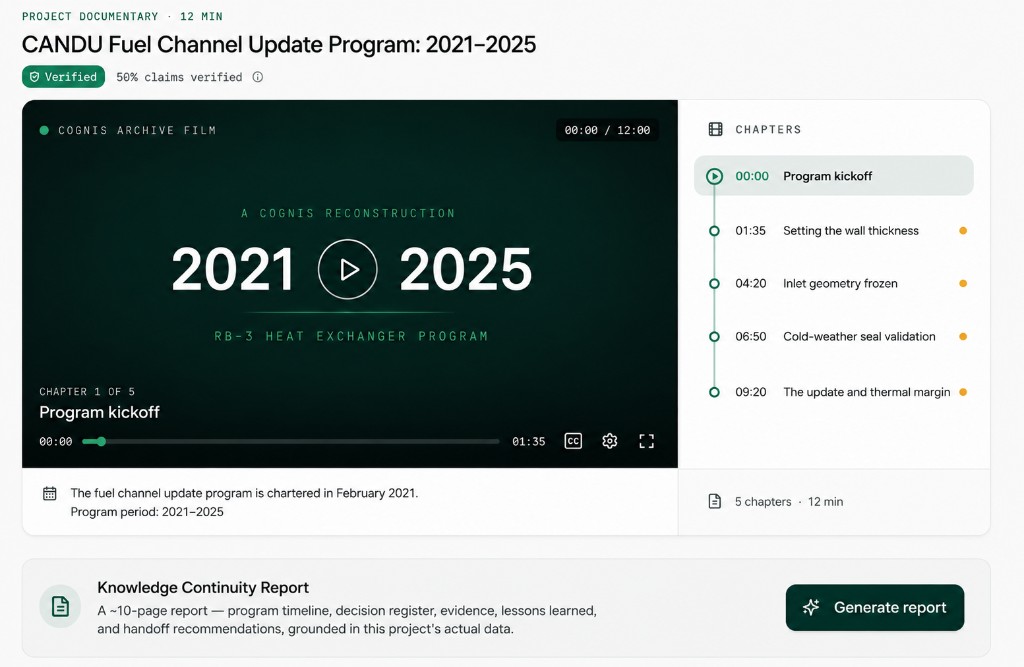
One knowledge graph under every stage.
Agents are only as trustworthy as the ground they stand on. Cognis builds a linked graph of your artifacts — CAD revisions, simulation runs, test campaigns, standards, captured decisions — and every agent in the harness reads and writes to it. That is why answers agree, and why they can be audited.
Built for work where being wrong is expensive.
Cognis is designed for teams whose simulation context, institutional memory, and validation history must survive across programs — and across careers.
Safety-case continuity
Shielding analyses, thermal-hydraulic runs, and licensing rationale stay linked and defensible across decade-long programs and staff transitions.
Design-loop acceleration
Trade studies grounded in prior programs, solver runs tracked to requirements, and certification evidence compiled as the work happens.
Program knowledge transfer
Cleared-environment deployment with full audit trails. When a program hands over, the reasoning transfers with the artifacts.
Asset-life engineering
Forty-year assets outlive their designers. Cognis keeps the original tradeoffs and validation history answerable in plain language.
Research-to-engineering handoff
Experimental context, simulation campaigns, and analysis decisions carry across rotating postdocs and multi-institution projects.
Expert-knowledge retention
The retiring specialist's judgment — why this alloy, why that tolerance — is captured against real artifacts before the exit interview.
Runs where your data is allowed to live.
Deep-tech data doesn't leave the building — so Cognis goes to it.
Air-gapped & on-premise
Deploys fully inside your perimeter, including disconnected environments. No data leaves your network; models run where the artifacts are.
Access control at the retrieval layer
Permissions are enforced when knowledge is retrieved, not filtered after generation. An agent can only reason over what its user is cleared to see.
Full audit trail
Every agent action, retrieval, and generated claim is logged and traceable — the same discipline your compliance reviews already demand.
Common questions.
01What systems does Cognis connect to?+
02Does it replace our existing tools?+
03How do we know agent answers are right?+
04Can it run in classified or air-gapped environments?+
05How is Cognis priced?+
See the harness run on your engineering.
A 30-minute technical walkthrough — your lifecycle, your systems, no slides.